
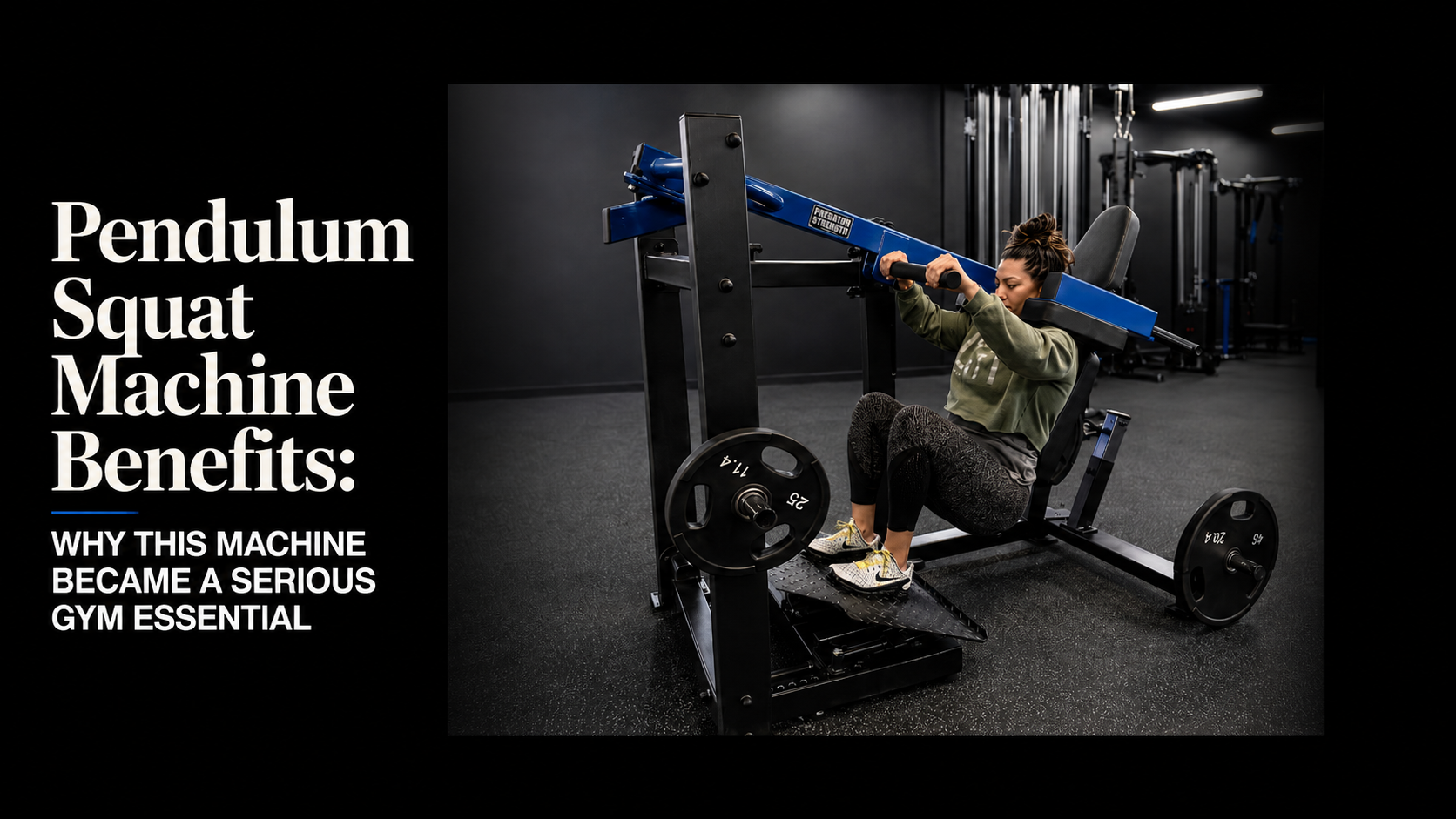
Pendulum Squat Machine Benefits: Why This Machine Became a Serious Gym Essential
A good pendulum squat does not feel like a compromise. It feels like a weapon. When lifters talk about pendulum squat machine benefits, they are usually talking about one thing first: brutal, controlled lower-body loading without the usual trade-offs that show up with barbell squats in tired shoulders, cranky lower backs, or crowded training floors.
That matters if you run a serious facility or build a private gym for hard training. The best machines are not there to replace effort. They are there to direct it better. A well-designed pendulum squat can create a squat pattern that is stable, aggressive, and repeatable under heavy load, which is exactly why it has become a standout piece in bodybuilding gyms, strength-focused facilities, and premium training spaces.
The Predator Strength Pendulum Story
In 2020, Vedran Presečki, owner of Predator Strength, developed the Predator Strength Super Pendulum Squat with one clear idea: to build a better machine than the original Paramount-style pendulum squat concept. The key was not simply making the machine heavier or more aggressive. The real breakthrough was the adjustable footplate system, designed with both angle regulation and forward/backward adjustment to create better biomechanics for different body types, stances, and training goals.
In 2021, the machine was redesigned in collaboration with Coach Kassem. His input significantly altered and refined the machine, turning it into a more advanced, more precise, and more performance-focused version of the original idea. From 2021 onward, the Predator Strength Super Pendulum Squat gained a strong reputation in personal training and bodybuilding circles, where many coaches and serious lifters started referring to it as the “GOAT” or the No.1 pendulum squat.
After years of promotion across Europe, Korea, China, and other international markets, the industry began moving in the same direction: more adjustment, more biomechanical control, and more serious pendulum squat development. By FIBO 2025, the trend was impossible to ignore. Pendulum squat concepts were everywhere, with many fitness equipment producers bringing their own version to the show. What started as a niche machine for serious lower-body training became one of the hottest categories in strength equipment.
Why pendulum squat machine benefits stand out
The biggest advantage is not that the movement is easier. It is that the machine can make hard training more precise. A pendulum squat shifts the loading pattern in a way that lets many lifters drive deep knee flexion and keep constant tension on the quads while staying more supported than they would in a free-weight squat.
That changes the training effect. Instead of spending half the set managing bar position, balance, torso angle, and fatigue leaking into the lower back, the lifter can attack the target muscles. For bodybuilding, that is gold. For athletes and coaches, it creates a dependable lower-body strength stimulus that is easier to standardize across different body types and training levels.
There is also a practical side for facilities. A machine that delivers a hard, intuitive squat pattern gets used. It earns floor space because members understand it quickly, advanced lifters can push it brutally hard, and coaches can plug it into programs without a long learning curve.
More quad loading with less energy wasted
One of the clearest pendulum squat machine benefits is how efficiently it drives quad dominance. Depending on the machine geometry, footplate angle, resistance curve, and user setup, the movement can reward knee travel and deep flexion in a way that lights up the front of the thighs fast.
For hypertrophy work, that is a major advantage. Lifters can keep tension where they want it instead of losing output to balance demands. On a strong machine, the path feels natural and aggressive. You descend under control, hit depth, and drive through a fixed pattern that lets the quads do serious work from the first rep to the last ugly one.
That does not mean glutes disappear. They are still involved, especially at depth and through the drive out of the bottom. But the pendulum squat has earned its reputation because it can hammer the quads with a level of consistency many lifters struggle to create with a barbell alone.
Adjustable biomechanics are not a luxury
This is where machine design separates serious equipment from catalog decoration. A pendulum squat can only be as good as its geometry, footplate, range, resistance feel, and user adjustability. Small changes in foot position, angle, and distance can dramatically change how the movement feels through the knees, hips, ankles, and lower back.
That is why the adjustable footplate became such an important part of the Predator Strength Super Pendulum Squat. Angle regulation allows the lifter to fine-tune foot pressure and joint position. Forward and backward regulation gives more control over stance, body position, and loading emphasis. For one athlete, the goal may be maximum quad bias. For another, it may be a deeper, more balanced squat pattern with better hip involvement. A fixed footplate forces the user to adapt to the machine. A better machine adapts to the user.
In real training environments, that matters. Different body types do not move the same way. A tall lifter, a shorter bodybuilder, a power athlete, and a general gym member may all need slightly different setup options to get the best result. More intelligent adjustment means better biomechanics, better comfort, better output, and more trust from serious coaches.
Joint-friendly does not mean soft
A lot of lower-body machines get marketed as “easier on the joints,” which usually sounds watered down. In a proper pendulum squat, joint comfort comes from better mechanics and support, not from making the movement soft.
For many lifters, the shoulder and wrist position is an immediate upgrade over back squats. There is no need to crank into external rotation to hold a bar. The torso support and machine path also reduce how much the lower back has to stabilize under fatigue. That can be a huge win for bodybuilders in high-volume phases, taller lifters who hate certain squat setups, or athletes managing accumulated wear without wanting to stop training hard.
The knee question is more nuanced. A pendulum squat can involve significant knee flexion, and that is exactly why it can be so productive for quad growth. But machine quality matters. If the path is off, the footplate is poorly designed, or the resistance profile feels awkward, the movement can go from powerful to irritating fast. Good biomechanics are not marketing fluff here. They are the difference between a machine lifters chase and one they avoid.
Stability increases output
When the body does not have to fight for balance, it can put more into the set. That is one of the most underrated pendulum squat machine benefits. Stability is not just about safety. It is about output.
On a strong pendulum squat, lifters can push close to failure with fewer moving parts to manage. That makes techniques like controlled eccentrics, paused reps, high-rep burnouts, and rest-pause work more practical. In hypertrophy programming, this matters because the best muscle-building sets are often the ones where effort stays locked into the target pattern rather than spilling into survival mode.
Facility owners should pay attention to that. Members remember machines that let them train brutally hard while still feeling locked in. Those machines become anchor pieces. They create identity on the gym floor, and they help separate serious equipment from generic catalog hardware.
Easier progression and cleaner coaching
Free weights are essential, but they are not always the cleanest tool for progression in every context. A pendulum squat machine makes progression easier to track because the movement pattern is more repeatable. Load goes up, reps go up, range stays honest, and the coach or lifter gets clearer data.
That is valuable in group training environments, personal training studios, and performance facilities where consistency matters. If five different athletes use the same machine, you still get some individual variation in stance and setup, but you remove a lot of the chaos that comes with free-weight squatting.
For less experienced lifters, it can also shorten the gap between “learning the lift” and “actually training the legs.” They still need coaching, but the machine can let them feel a hard squat pattern sooner. For advanced lifters, the value is different. They already know how to strain. The machine simply lets them direct that strain with more precision.
High reward with lower technical fatigue
Not every lower-body session needs to be a technical event. There are times when lifters need to train hard without spending their best energy on bar path and setup. This is where the pendulum squat becomes especially useful.
It delivers a lot of stimulus with less technical fatigue than many free-weight options. That makes it ideal for secondary squat work, hypertrophy blocks, deload-adjacent phases where heavy loading still matters, or leg sessions built around high effort and high volume. The athlete can save mental bandwidth while still crushing the lower body.
That said, it is not a magic replacement for everything. If a powerlifter needs competition specificity, a machine cannot give them that. If an athlete needs to express force in less constrained patterns, other tools still matter. But for pure leg training, especially when the goal is size, repeatable effort, and heavy work without unnecessary wear, the pendulum squat is hard to beat.
A premium machine adds value beyond the lifter
For gym owners, one of the real pendulum squat machine benefits has nothing to do with anatomy charts. It is business. Distinctive, high-performance lower-body machines shape how members perceive the entire facility.
A serious pendulum squat tells people your gym was built for training, not just traffic. It becomes a visual signature piece and a practical one at the same time. Members post it, talk about it, and program around it. Coaches use it because it works. Strong lifters respect it because it does not feel like a watered-down leg press pretending to be something else.
This is where premium manufacturing matters. Heavy-duty construction, stable frame design, quality upholstery, precise movement, and durable finish all influence long-term value. In commercial use, the machine has to survive abuse, look the part, and keep delivering the same feel after years of hard sessions. Cheap equipment rarely holds up on all three.
That is why serious buyers look beyond the fact that a pendulum squat exists. They look at how it is built, how it loads, how the resistance feels through the range, and whether the machine belongs in a high-performance environment. Predator Strength understands that standard because hardcore gyms do not need another average machine taking up premium floor space.
Who gets the most from it
Bodybuilders and physique-focused lifters are obvious beneficiaries because the machine is so effective for accumulating hard quad volume. Strength athletes benefit when they need lower-body work that does not beat up the upper body or spine the same way repeated barbell sessions can. Coaches benefit because the machine is easier to standardize and easier to dose.
Private gym owners get value if they want one lower-body piece that feels elite and delivers a lot of training variety. Commercial facility operators get value if they want a machine that draws serious members and holds up under repeated use. The common thread is simple: this is not a beginner novelty piece. It is a high-output tool for environments that respect hard training.
The right pendulum squat will not make training easier. It will make your effort count more. If that is the standard you build around, the machine earns its place fast.
Check Predator Strength pendulum https://www.predatorstrength.eu/super-pendulum-squat-v-4-0kh-kassem