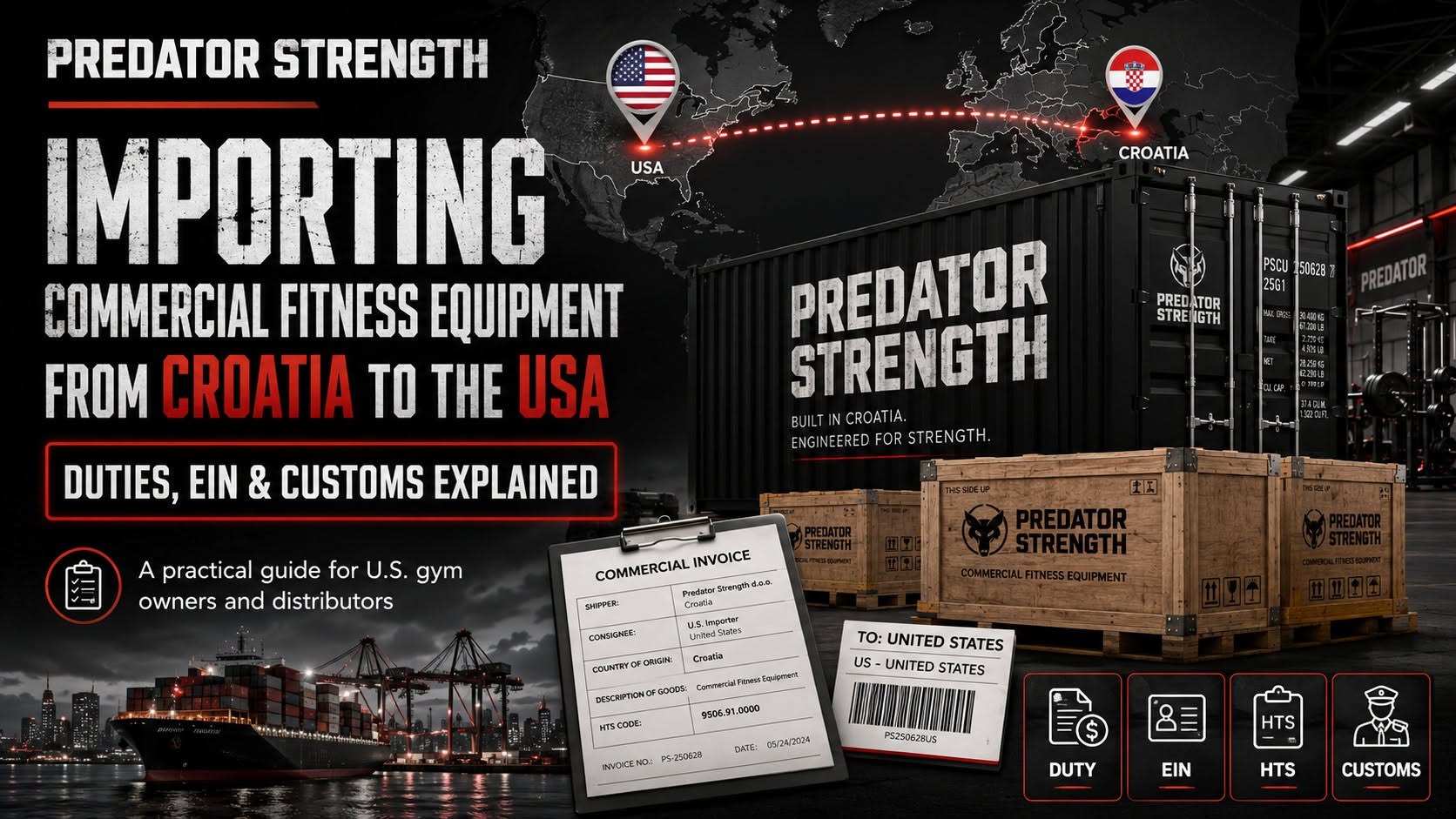
Importing Commercial Fitness Equipment from Predator Strength Croatia to the USA: Customs, Duties and Import Requirements Explained
When importing commercial fitness equipment from Predator Strength in Croatia to the United States, buyers often ask:
**Do I need to pay VAT? Do I need an EORI number? What documents are required?**
The simple answer is:
**The USA does not use VAT like the UK or EU, and U.S. importers do not normally need an EORI number.**
Instead, the U.S. import process is handled through U.S. Customs and Border Protection, usually with a customs broker, an Importer of Record, an importer identification number, HTS classification, customs duty, import fees and entry documents.
## 1. Is commercial fitness equipment exempt from VAT in the USA?
The USA does not have a federal VAT system like the European Union or the UK.
So the correct question is not:
**“Is fitness equipment VAT exempt in the USA?”**
The better question is:
**“What customs duty, import fees and possible state sales/use taxes apply when importing fitness equipment into the USA?”**
Commercial gym machines, racks, benches, plate-loaded machines and strength equipment are normally treated as imported commercial goods.
They are not automatically tax-free just because they are used in a gym, sports facility, commercial fitness center or training business.
## 2. Croatian VAT vs U.S. import charges
Croatia is part of the European Union. The United States is outside the EU.
For the Croatian exporter, the sale is normally treated as an export from the EU to a non-EU country. In many cases, the Croatian supplier can issue the invoice without Croatian VAT, provided the correct export documentation proves that the goods left the EU.
However, this does not mean the goods enter the USA without costs.
Instead, import costs are handled on the U.S. side.
In simple terms:
**Croatian VAT: normally not charged on export outside the EU, if export proof is correct.
U.S. VAT: not applicable because the USA does not use VAT.
U.S. import duty and fees: normally handled during customs clearance.
State sales/use tax: may apply depending on the U.S. state and business situation.**
## 3. Do I need an EORI number to import into the USA?
No, a U.S. importer does not normally need an EORI number.
EORI is mainly used in the European Union and some UK import/export procedures. The USA uses its own customs identification system.
For U.S. imports, the buyer normally needs an importer identification number. For a U.S. business, this is usually the company’s **EIN** — Employer Identification Number.
If a business does not have an EIN, other importer identification methods may apply, but for serious commercial imports, a U.S. company should normally use its EIN.
So the USA equivalent question is not:
**“Do I need EORI?”**
The better question is:
**“Who will be the Importer of Record, and what importer number will be used for U.S. customs clearance?”**
## 4. What is the Importer of Record?
The **Importer of Record** is the party responsible for importing the goods into the United States.
The Importer of Record is responsible for:
* Correct customs declaration
* Correct product classification
* Correct customs value
* Payment of duties, taxes and fees
* Compliance with U.S. import rules
* Providing required documents
* Responding to U.S. Customs if there are questions
For most Predator Strength shipments to the USA, the U.S. buyer, distributor or receiving business should normally act as the Importer of Record.
If the buyer is opening a gym or importing equipment for business use, they should confirm this with their customs broker before shipping.
## 5. Do I need a customs broker in the USA?
For commercial fitness equipment, using a licensed U.S. customs broker is strongly recommended.
This is not a small parcel shipment. Commercial gym equipment is heavy, high-value and often shipped by sea freight or freight forwarding. Mistakes in customs documents can cause delays, storage costs, port charges and extra stress.
A customs broker can help with:
* Customs entry
* HTS code classification
* Duty calculation
* Customs bond
* Importer of Record setup
* Commercial invoice review
* Packing list review
* Bill of lading / airway bill
* Import fees
* CBP communication
* Final delivery coordination
Trying to import a container or pallet of commercial gym equipment without a broker is like trying to assemble a gym machine without bolts: possible in theory, ugly in reality.
## 6. What HTS code applies to fitness equipment?
Commercial fitness equipment is often classified under:
**HTS 9506.91.00 — Articles and equipment for general physical exercise, gymnastics or athletics; parts and accessories thereof.**
This category can include many types of gym and exercise equipment.
However, the final HTS classification must always be confirmed by the customs broker or a customs classification specialist. Different products, parts, accessories or electronic components may sometimes require different classification.
For many types of fitness equipment under HTS 9506.91.00, the current general U.S. duty rate is commonly listed as **4.6%**.
However, this should not be treated as a final legal quote. U.S. tariff rules can change, and additional duties or Chapter 99 measures may apply depending on the product, origin, material and current trade rules.
The safe approach is:
**Confirm the HTS code and duty rate with a U.S. customs broker before shipping.**
## 7. Is there a customs bond?
For many commercial imports into the USA, especially shipments valued over USD 2,500, a customs bond is normally required.
There are two common options:
1. **Single-entry bond** — for one shipment
2. **Continuous bond** — for regular importers bringing multiple shipments into the USA
For a gym owner importing one full equipment order, a single-entry bond may be enough. For a distributor importing Predator Strength equipment regularly, a continuous bond may be more practical.
The customs broker can arrange this.
## 8. What documents are normally needed?
For importing Predator Strength commercial fitness equipment from Croatia to the USA, the buyer and customs broker will usually need:
1. Commercial invoice
2. Packing list
3. Bill of lading or airway bill
4. Buyer/importer EIN or importer number
5. Importer of Record details
6. Customs broker power of attorney
7. HTS code / tariff classification
8. Country of origin: Croatia / European Union
9. Proof of origin, where required
10. Customs bond
11. Arrival notice from freight forwarder
12. CBP entry documents
13. Delivery address and final consignee details
For larger shipments, especially sea freight, the broker or forwarder may also handle additional pre-arrival filing requirements.
## 9. Are there state taxes in the USA?
The USA does not have a federal VAT, but many U.S. states have sales tax or use tax systems.
Whether state sales tax or use tax applies depends on the state, the buyer’s tax status, the purpose of the equipment, resale status, exemption certificates and local rules.
For example:
* A distributor buying equipment for resale may have different tax treatment than a gym buying equipment for its own use.
* A gym may owe use tax in its state even if no sales tax was collected at import.
* Some buyers may have exemption certificates, but this depends on state law.
This is why the buyer should also speak with their U.S. accountant, not only the customs broker.
The customs broker handles import clearance.
The accountant handles state tax treatment.
Both matter.
## 10. Practical import process
A typical process looks like this:
1. U.S. buyer confirms equipment order with Predator Strength Croatia
2. Buyer selects a freight forwarder and U.S. customs broker
3. Buyer provides EIN and Importer of Record details
4. Predator Strength prepares commercial invoice and packing list
5. Broker confirms HTS code and estimated duty/fees
6. Freight is booked by sea or air
7. Export from Croatia/EU is documented
8. Goods arrive at the U.S. port or airport
9. Customs broker files the customs entry
10. Import duty, fees and bond requirements are handled
11. Goods are released by CBP
12. Shipment is delivered to the gym, warehouse or distributor
## 11. Sea freight vs air freight
For commercial fitness equipment, sea freight is usually the most practical option.
Most Predator Strength machines are heavy, steel-built and made for serious gym use. Air freight can be much faster, but the cost can become very high.
Sea freight is usually better for:
* Full gym orders
* Multiple machines
* Palletized shipments
* Distributors
* Large commercial projects
Air freight may make sense only for urgent parts, smaller items or very time-sensitive shipments.
## 12. Final answer
Commercial fitness equipment imported from Predator Strength Croatia to the USA is normally treated as imported commercial goods.
The USA does not use VAT like the EU or UK, and U.S. buyers do not normally need an EORI number.
Instead, the U.S. buyer should prepare:
* EIN or importer identification number
* Importer of Record details
* U.S. customs broker
* HTS classification
* Customs bond
* Commercial invoice
* Packing list
* Freight documents
* Payment of applicable import duties and fees
* State sales/use tax advice from an accountant
For most commercial gym equipment, the safest route is simple:
**Use a U.S. customs broker before shipping. Confirm HTS code, duty rate, bond requirements and documents in advance.**
That keeps the import process clean, professional and predictable.
Source notes for the blog: EU guidance says VAT is not charged on exports of goods outside the EU, but the exporter must keep proof that the goods left the EU. CBP states that import paperwork asks for an importer number, usually the IRS business registration number for businesses. U.S. customs entry rules require key documents such as a commercial invoice and packing list where appropriate, and formal entry summary uses CBP Form 7501/electronic equivalent. CBP guidance says a customs bond is required for commercial imports worth more than $2,500, and CBP lists current merchandise processing fee limits.https://www.help.cbp.gov/s/article/Article-1214..
